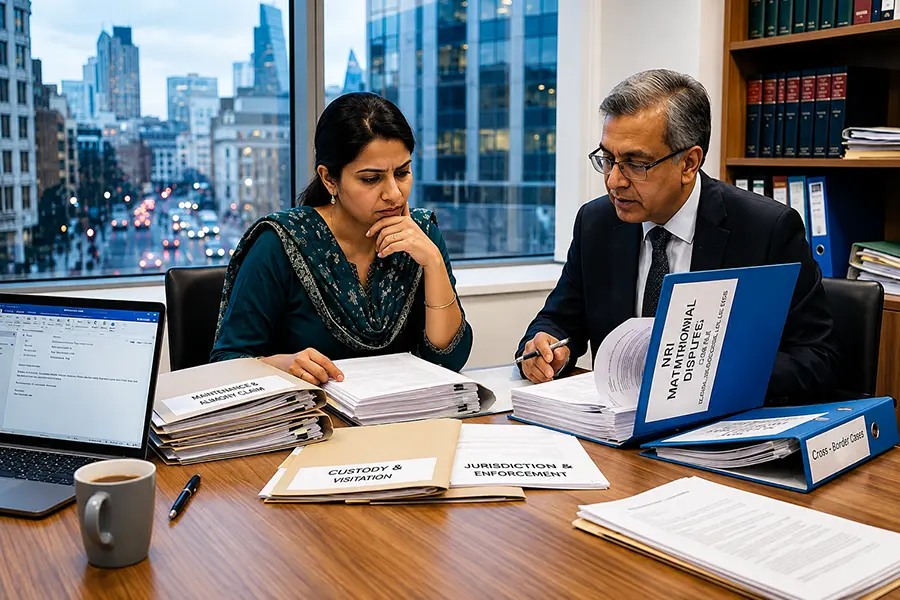
When Mr. Kumarswamy stepped off a jet onto the humid Mumbai ground after ten years abroad, he imagined a simple homecoming. He expected that the legal doors he’d left open overseas would line up neatly with those back home. Instead, he found himself tangled in a maze of statutes, conflicting regulations, and bureaucratic inertia—revealing one painful truth: a case may close in one jurisdiction, but it can stay alive, even intensify, in another.
1. The Promise and the Paradox
Mr. Kumarswamy’s startup – a digital-mobility platform – was built in the U.S., securing all requisite licenses, filing patents, and erecting a solid fintech backbone without a single legal hiccup. When he returned to India, he assumed the system would mirror that of the U.S. Yet, a week after re-establishing his residency, a cascade of unrelated regulatory notices hit the desk, demanding compliance with a brand-new set of data-protection rules that India had only just enacted.
This isn’t a lone anomaly. Many NRIs who lived overseas discover that the statute of limitations, enforcement mechanisms, and administrative procedures in India can differ starkly from those they knew. A lawsuit may have hung up on U.S. paper, but the corresponding Indian law can keep the claim alive for years.
2. The Clash of Courts
In India, civil procedural law leans heavily on Supreme Court decisions, judicial precedents, and executive statutes. Unlike the U.S., where a statute of limitations can wipe a claim clean after a set period (six-ten years, typically), Indian courts allow certain disputes— especially those involving intellectual property or foreign investment— to remain active until fully adjudicated. That means a legal issue that closed abroad can be reopened, dragging the same litigant through a double-layered judgment.
Even if a U.S. court dismisses a case, the Indian court can revisit it, issuing new claims, penalties, or restitution orders that were unthinkable back home.
3. The Bureaucratic Labyrinth
Once a case flags abroad, the Indian bureaucracy steps in. The Central Bureau of Investigation (CBI) or FIR units may launch separate investigations. Even if the case already closed, the Ministry of Law & Justice can petition for censure or re-filing under newer guidelines. What follows is a shift from a tidy dismissal to a chaotic ongoing inquiry, costing more than money—draining time, mental health, and public image.
Mr. Kumarswamy saw this when Mumbai police opened an inquiry into an alleged “unfair trade practice” that had no basis in his U.S. filings. Even after the U.S. court acquitted him, the Indian authorities remained unmoved, forcing his company into legal cross-fire that threatened to erode morale.
4. Emotional Toll: The Unseen Consequence
Beyond paperwork and penalties, the psychological impact is often overlooked. For NRIs, the homecoming can feel less like a return and more like a jungle, when bureaucracy turns familiar territory into an enemy of legal and financial peace. The internal clash – between life abroad and reality at home – leaves a deep sense of displacement and identity crisis.
Think of your own transitions. Did stepping back into your birthplace feel more hostile than welcoming because of a lingering bureaucratic chase? Emotional resonance like this helps readers grasp the weight of these cross-border legal intricacies.
5. Swarm the System—What Can Be Done?
- Pre-emptive Legal Planning – Engage comparative legal counsel in both jurisdictions, drafting cease-fire agreements that pause litigation if matters diverge.
- Continuous Legal Surveillance – Subscribe to cross-border legal monitoring services that flag pending claims on either side.
- Robust Corporate Governance – Transparent controls, due-diligence protocols, and dispute-management frameworks can absorb the impact of unrelated cases.
- Political Advocacy – Legal reforms via public pressure or lobbying can shift the balance, offering compromise avenues.
- Plan for the Unexpected – Build a financial safety net for surprise court clerks, or a contingency plan that deploys within 48 hours.
6. The Take-Away
Nothing is “over” when your legal life spans multiple countries. One jurisdiction’s resolution won’t erase another’s claims. As an NRI, you must consider the possibility that past legal battles never truly ended. When planning your return, keep future unresolved threads on your radar and understand how they’ll unfold in the broader cultural fabric you’re re-entering.
A legal matter resolved in one country may still have consequences in another. NRIs should understand the legal position in every jurisdiction connected with their affairs.
— MR. VIVEK KRISHAN SOODFOUNDER, MOOV INC ADVISORY
Disclaimer: This article is for general information only and does not constitute legal advice. Cross-border legal matters may depend upon the facts, applicable laws, jurisdiction, limitation periods, court orders and other circumstances. Please consult a qualified legal professional for advice relating to a specific matter.